Failed Gym Membership Payments? Here’s What to Do
Around1 in 15
bank direct debits to UK fitness facilities failed in September 2026.Source: Office for National Statistics
Failed gym membership payments can interrupt your cash flow and create extra work for your team. But a failed payment doesn’t always mean a member can’t afford their membership.
Sometimes it’s simply a matter of timing, or money being held in another account.
Understanding why payments fail can help you recover the money while supporting your members.
More fitness payments are failing
The UK Office for National Statistics reported that the direct debit failure rate for fitness facilities rose from 5.7% in September 2025 to 6.6% in September 2026.
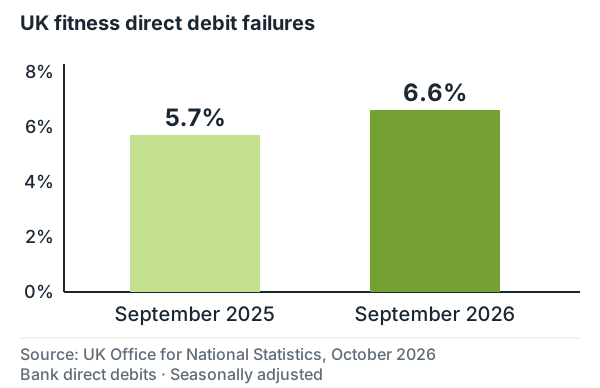
Even a small increase in failed payments can make a difference to a gym’s cash flow. Here’s what that could look like for a gym collecting weekly membership fees.
What could failed payments mean for your cash flow?
Cash flow hold-up
Based on $40 weekly memberships
150 members
$1,716
initially unpaid per month
Around 43 failed payments per month
500 members
$5,720
initially unpaid per month
Around 143 failed payments per month
Illustrative monthly estimates based on UK fitness direct debit data. Payments may be recovered.
A failed payment doesn’t always mean lost income
A failed payment doesn’t always mean lost income. Influx’s own payment data shows that most failed subscription payments can be recovered.
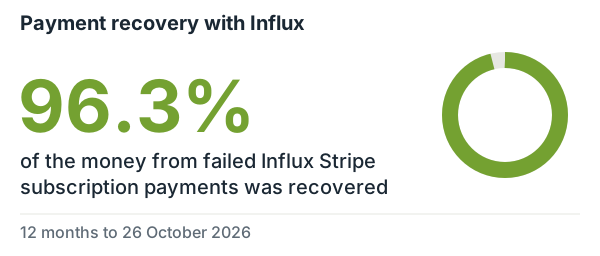
The key is understanding why the payment failed and knowing when to follow up.
Why gym membership payments fail
Insufficient funds is the most common reason
Insufficient funds is one of the most common reasons subscription payments fail. Churnkey’s research found it accounted for 81.4% of failed payments in Australia and 66% in the UK.
Influx’s own Stripe payment data showed a similar pattern, with around 81% of failures caused by insufficient funds.
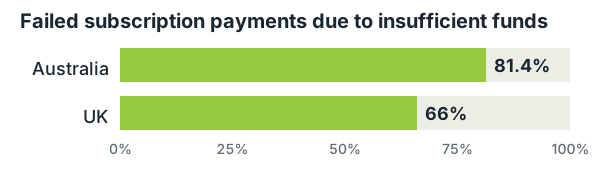
But an insufficient funds message only tells you that the money wasn’t available when the payment was attempted. It doesn’t explain why.
Sometimes it’s a matter of timing
For some members, the issue may be when their payment is due.
A 2026 Australian survey commissioned by GoCardless and conducted by YouGov found that 59% of respondents under 30 regularly moved money between accounts or delayed payments because bills were due before payday.
The money may be in another account
Money being in the wrong account can also cause problems.
Australian bank Up found that 60% of customers who went overdrawn had enough money in another Up account to cover the balance by the end of the day.
Right amount, wrong account

60%
of overdrawn customers had enough money in another account that day.
Source: Up customer account data. Not specific to gym payments.
This research looked at overdrawn accounts, not specifically gym payments. For gym owners, it’s a useful reminder that a failed payment doesn’t always tell the whole story. Sometimes a member simply needs time to move money or wait until payday.
Financial pressure can affect memberships
Of course, not every failed payment is a timing issue. Some members may be experiencing financial pressure, and membership costs can become harder to manage.
The Health & Fitness Association estimated that New Zealand fitness industry revenue grew by 3% in 2025, despite a challenging economic environment.
Even with industry growth, cost remains a concern for some members. UK research highlights this:
27% of people in the UK who cancelled a gym membership said it was too expensive.
Source: YouGov data cited in UK gym chain PureGym’s UK Fitness Report.
Whatever the reason, a straightforward conversation can help you understand the situation before deciding what to do next.
What should gym owners do when a payment fails?
Check the reason before retrying
Before retrying a failed payment, check the decline reason and whether another attempt is already scheduled.
If the issue is insufficient funds, immediately retrying may not help. Allowing a few days can give the member time to make funds available.
Payment providers such as Stripe may also schedule automatic retries, so it’s worth checking before attempting another payment manually.
Consider the cost to your member
A failed payment can affect your member too. Depending on the payment provider and agreement, they may face a dishonour fee.
It can also be frustrating when a payment fails unexpectedly, particularly if they believed enough money was available.
Clear information about the failure helps you resolve the issue without unnecessary back-and-forth.
A simple follow-up can help
Payment problems can be uncomfortable to discuss. A private, straightforward message gives members an opportunity to respond without feeling judged.
When a payment fails:
- Check the decline reason.
- Contact the member privately and let them know what happened.
- Check for an existing retry before attempting the payment again.
- Agree on the next step, whether that’s waiting until payday, updating payment details or contacting the provider.
How Influx helps
Influx alerts you when a payment fails, so you can follow up without having to find the problem yourself.
For Stripe payments, you can check the decline reason and retry the payment when appropriate.
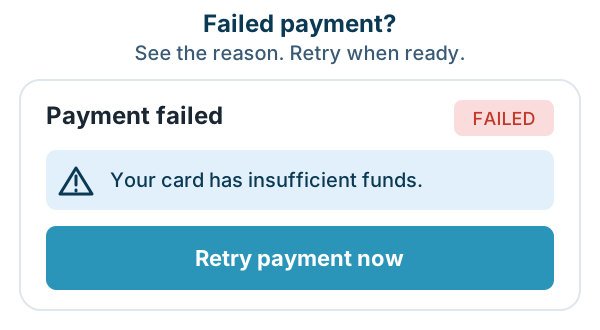
If a member pays another way, you can also disconnect the invoice from Stripe and record a manual cash payment.
Failed gym membership payments are frustrating, but they don’t always mean lost income. Understanding the reason, checking when to retry and communicating clearly with members can help keep payments on track.